Settings
 Fast Delivery
 Incoterms
 Payment Types


 Marketplace Product

Mfr Part # 2847
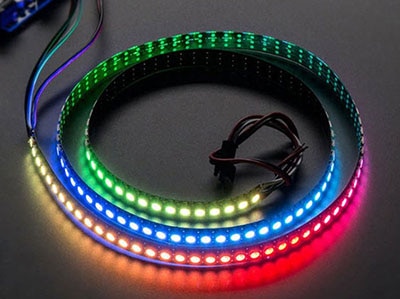
ADDRESS LED STRIP SERIAL RGBW 1M
Adafruit Industries LLC

License: See Original Project LED Strips LEDs / Discrete / Modules Microcontrollers Wifi Wireless
Guide by Erin St Blaine
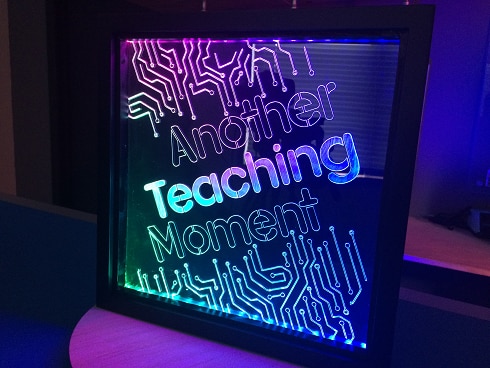
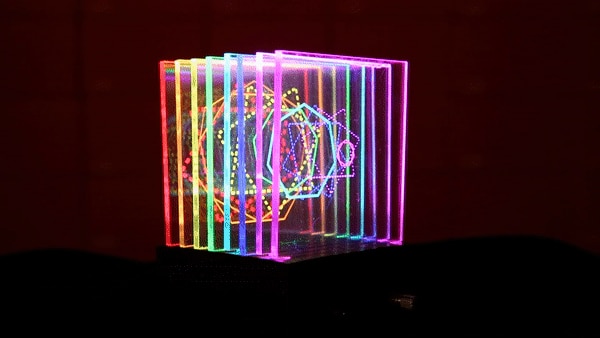
Make your sign or drawing glow with animated light. This is an easy beginner project that brings you joy again and again. Add NeoPixel LEDs to the edge of a piece of acrylic and when you draw or write on the plastic with chalk paint markers, the lights will make your artwork glow like neon.
But that's only the beginning! Install WLED on a Mini Sparkle Motion controller and take your project to the next level with moving light animations. Choose from dozens of different color palette presets, and a ton of different animations. Fade between your favorite colors. Change the speed or intensity of the light show with a few clicks on your phone. This is one of the easiest ways to control programmable lights, with no coding required.
A piece of 1/4" acrylic plastic (whatever size you like)
Clear packing tape or Silicone Adhesive
A tiny flat-head screwdriver
A pair of wire cutters / strippers
Soldering iron & accessories
The wiring is very simple for this project. Solder your LED strip as shown:
5v --> +5v
33 --> DI
G --> GND
Be sure you're connecting to DI (data IN) rather than DO (data OUT). These strips are directional and won't work if you connect to the wrong end.
The 144/m NeoPixel strip likely comes with wires already soldered onto the IN end. Look closely for arrows printed on the strip pointing the direction of data flow and be sure the arrows are pointing away from the end you're soldering to.
Cut off the connector with wire cutters and strip about 1/8" of shielding from the red, black, and white wires. The second black wire is unneeded for now.
Connect the wires to the Mini Sparkle Motion as shown: Red (+5v) to the 5v pin, green (DI) to pin 33, and white/black (some lots have different color coding) to G.
These strips are cuttable at any point. I recommend leaving the strip long until you know exactly how many lights you'll be using in your project and cutting to length during final assembly.
The assembly is the same on the version of the board with no screw terminal -- simply solder the wires directly into the +5v, G and 33 holes.
If you think you want to use this controller for more than one project, connect a 3-pin JST connector between the Mini Sparkle Motion and the LED strip. Now you can just unsnap the connector and use the controller with other strips or projects.
If you're new to soldering strips, check out our How to Solder NeoPixels guide here.
You'll be able to power the lights directly through the onboard USB port, and the microphone is already integrated -- so that's all the wiring which needs to be done!
This page will guide you through how to install WLED on the Mini Sparkle Motion.
The Mini Sparkle Motion has a USB to serial chip which may need a driver installed before you can install WLED. Head over to the How to Install Drivers for WCH USB to Serial Chips tutorial and download and install the new driver.
These next steps require a Web Serial-compatible browser. As of this writing, that means Google Chrome, Microsoft Edge, or Opera “desktop” browsers. Other browsers (Safari, Firefox, Explorer and anything mobile) won’t work.
Visit https://install.wled.me/
Plug your microcontroller into your computer with a known good USB cable. Click "Install" and select the port for your board.
Depending on the USB-to-serial bridge chip on the board, you might see one or two serial ports. On Mac, for instance, there might be both “/dev/cu.usbmodem[number]” and “/dev/cu.wchusbserial[number]”. Use the “wchusbserial” one.
After successful installation, enter your WiFi network name and password when prompted. This must be a 2.4 GHz WiFi network; ESP32 does not support 5 GHz networks. If it can’t connect, then as a fallback WLED will create its own 2.4 GHz WiFi access point.
If you don't see the "Connect to Wi-Fi" prompt, you'll need to set up your WiFi network using AP (access point) mode. Open up your WiFi settings and look for a WiFi network called WLED-AP. Connect to this network using the default password wled1234. The WLED interface will pop up in its own browser.
From here, go into Config/Wifi Settings and enter your WiFi credentials near the top. Give your project a name in the mDNS field a little further down the page. Now you can type in "projectname.local" (where "projectname" is your mDNS name) into any web browser on the same wifi network to access your microcontroller.
You can also scan the QR code below to open access point mode.
For more help and troubleshooting tips visit the Getting Started page on the WLED knowledge base.
Head to the WiFi Setup screen under Config and create a good URL so you can control your project from any web-enabled device. Call it something you'll remember, that's easy to type into any web browser on your WiFi network in order to connect to your project.
In Safari or Chrome on your phone or computer, type in this web address to access the WLED interface: http://projectname.local (where "projectname" is whatever you put into this field).
Check out the Additional Settings page for more info on accessing your project. WLED has an "access point mode" that doesn't require a WiFi network for when you're out on the go. It's also helpful to download one of the WLED apps to help manage and organize your projects.
Do this first before setting up your LED preferences with your GPIO number.
Click on "config" and head to the USERMODS tab. Scroll down a bit and you'll find the AudioReactive section.
Click the box to enable, then enter the settings and the Digitalmic section as follows:
Type: SPH0654
Pin I2S SD: 9
Pin I2S WS: 10
Pin I2S SCK: 23
The other pins are unused.
Reboot your Sparkle Motion Mini for changes to take effect.
LED Setup
Next, head to the LED Preferences tab under the Config menu.
Scroll down to Hardware Setup.
We're using an RGBW strip so pull down the first dropdown and select SK6812/WS2814 RGBW.
Put your total number of LEDs into the Length field (if you're not sure yet, just put in 100), and change GPIO to pin 33, the GPIO NUMBER associated with the LED data pin on your Mini Sparkle Motion. Make sure to select the correct Color Order for your LEDs as well.
For RGBW LEDs, you can also select how the white appears. I chose "Brighter" so it really makes my marker colors pop.
If this number appears in red and won't let you select it, check the previous step: this board is configured with pin 33 assigned to the microphone, so you need to change it there before you can set it up as your LED GPIO.
Now you can use any computer or handheld device to control your LEDs.
Make sure your device is on the same WiFi network as your board. Navigate to your custom URL (projectname.local/ ) in a web browser. You'll see a color picker above a whole bunch of color palette choices.
Choose a color, choose an effect, and watch your lights animate and glow!
Save your favorite combinations as presets, create playlists, control the speed and intensity of the animations, and lots more. This web app is incredibly intuitive and easy to use.
Head over to the WLED wiki at https://kno.wled.ge/ to delve into all the particulars.
If your lights didn't come on, here are a few things to try:
Head back to WLED and check your pinout configuration under LED Preferences. Be sure the pin number is the correct GPIO for the attachment point you used.
Check your wiring! Be sure you connected to the IN end of the LED strip. These strips can be inconsistent, so this is a pretty common problem. Use an alligator clip to try connecting the data wire on the other end (the power and ground wires should work from either end).
Try re-uploading the WLED software.
If the lights come on but you can't control them: i.e., you type in "projectname.local" into your browser and it won't connect, make sure you're on the correct WiFi network. If you're on a different network than the one you set up the software on, you won't see the WLED connection.
If your lights came on in blue or green instead of yellow, your color order is wrong. See below to fix.
If only half your lights came on, be sure you've got the correct number in the "length" field under LED preferences.
If your lights came on in a variety of weird colors and looking like a 1950s diner interior, you may have the wrong LED strip type selected. RGBW strips and RGB strips are not the same, so be sure you've got the correct strip type, or you'll get very odd behavior.
If your microcontroller hangs or keeps rebooting, or gets really hot, you may have the power and ground lines switched. Unplug right away and check: this is a fast way to brick your controller.
Once your lights are working, it's time to attach them to the acrylic.
A cleanly cut edge will transmit a lot more light than a rough edge. This plastic can be cut with wood-shop tools, like a table saw or chop saw, but you'll get slightly better results if you use the professionally cut edge or cut it to size with a laser cutter. Lasers are fun but definitely not necessary -- a table saw will work just fine.
Practice safety protocols with using any cutting instrument, including appropriate eyewear. Older makers should help younger makers.
If you're using this indoors and just want to quickly attach the lights and test it out, your best bet is to use clear packing tape. This tape will stick very well to both the acrylic and the silicone sleeve around the LEDs. It disappears against the plastic and comes off easily if you ever want to re-use your LED strip for another project.
Stick the LED strip down to the center of the tape and then wrap the edges around the acrylic, to be sure it's all centered.
You really only need to cover one edge for acrylic signs up to around 24" wide. If your project is larger than that, or if you're just not getting the glow you want in the middle, wrap the lights around two or three sides, or even all four.
For a more permanent installation, or if you want to put this outdoors, the best way I've found to attach the lights is with silicone adhesive. Not much sticks to the silicone sleeve of the lights, and they won't hold up to winter weather without the sleeve. Clear silicone glue will keep them on there permanently -- though be very careful not to get it onto the plastic anywhere else, since it's very hard to remove.
Be careful not to get adhesive on surfaces you do not want glue on. Read the directions on the glue package carefully.
Plug your Mini Sparkle Motion in, via the USB port, and the LEDs should light up the entire slate.
Open up the WLED interface by visiting the local URL (projectname.local) that you set up during assembly.
Play around with the colors and effects until you find something you like. For this project, I really like the Colorloop effect, which changes the strip all at once into whatever color palette you choose. You can speed it up or slow it down using the sliders at the bottom of the Effects panel.
Once you have something you like, save it as a Preset. If you want it to start up in that mode, check the "apply at boot" checkbox.
Get out your Liquid Chalk Markers and start drawing on your slate. It's a lot of fun to see how the different colored markers interact with the colored LED lights.
I printed out a coloring page mandala from the internet and placed it underneath my slate to give me a reference.
Go make some beautiful glowing artwork!